
The skinny on“Mysterious Skin”: An interview with gay writer Scott Heim
Updated: 5 days ago
By Gregg Shapiro

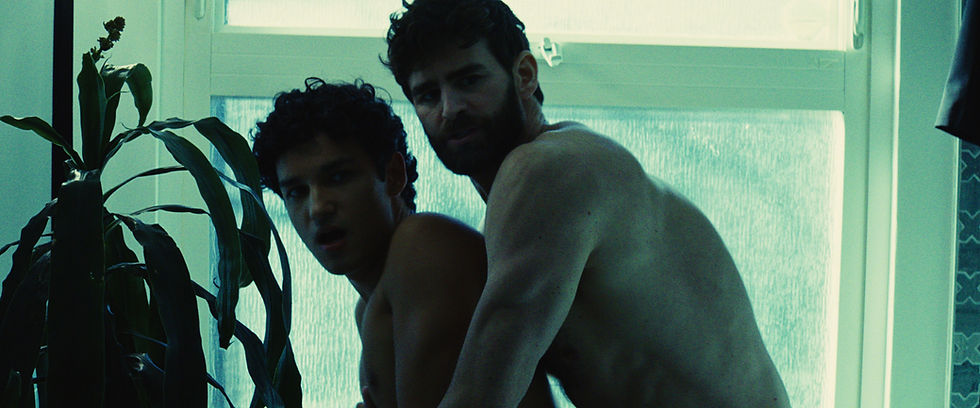
Gay writer Scott Heim has a couple of reasons to celebrate. First is that his acclaimed 1995 debut novel “Mysterious Skin” has been reissued by Harper Perennial in an anniversary edition featuring a new afterword written by Heim. Second, the 2004 movie adaptation of “Mysterious
Skin,” directed by gay filmmaker Gregg Araki, and starring Joseph Gordon Levitt and Brady Corbet,
along with Michelle Trachtenberg and Elizabeth Shue, is being rereleased theatrically in a 4K Restoration in August 2026. Scott generously made time for an interview between the reissue of the book and the rerelease of the movie.
Gregg Shapiro: Scott, is there one character from “Mysterious Skin” who you could point to as the inspiration for the novel? One who got the ball rolling, so to speak.
Scott Heim: I was working on my MFA at Columbia University, and I turned in a story that was basically about the character Neil in the present day (although I think his name was different in that story). While writing it, I was doing some research on "recovered memory," its questionable aspects, the different ways that people can remember similar past events, that sort of thing. By coincidence, I was also reading books by Budd Hopkins about UFOs and UFO abductions, and I realized how similar the memories (whether real or imagined) of abuse survivors and UFO abductees often sounded. I suppose that's the moment when my ideas for a novel began to take shape.
GS: Please say a few words about the multiperspectivity device you employed in the novel –
individual characters - Brian, Neil, Wendy, Deborah, Eric – narrate firstperson sections.
SH: At its core, “Mysterious Skin” is primarily a book about memory and its inconsistencies
and how no story is ever 100 percent true – that to really know something as clearly as
possible, you have to hear as many sides or versions, to keep peeling back layers of a story's "skin" or
"mystery" to get at the closest truth. Neil's version of events is so different from Brian's version of events, and for the reader to understand the truth as best as possible, I felt the best method of getting there would be to have multiple voices tell the story from different perspectives. I guess the title is ironic, in a way, because there's no mystery for the reader – to me, the interesting thing was always
taking the reader on a journey to figure out how the characters themselves are going to learn what is
true about their memories and what is false.
GS: Being that “Mysterious Skin” was your first novel, how much of you, if any, is in the characters?
SH: Oh, quite a bit. That's one of the fun things about working on something with multiple POVs. Parts
of me are Neil and parts are Brian, but I could say that about Eric and Wendy, too. The characters are also mirrored some people I grew up with, family and friends, etcetera. I grew up in these Kansas towns and had a lot of these experiences. But there's also many, many things that are completely sourced from my imagination. And really, it's my third novel that's far more autobiographical than “Mysterious Skin.”
GS: How soon after “Mysterious Skin” was published were you approached about a movie version?
SH: In retrospect, I realize that it really wasn't very long at all – within the first two years, maybe two and a half, a production company had contacted my literary agent asking about the rights. This wasn't Gregg or his producers, though – it was some of the people who'd produced the film “Swingers,” which came out in 1996, a year after “Mysterious Skin” came out in hardcover. That might seem a little strange, as the plot and characters and setting of “Swingers” really couldn't be more different than my book, but they were dead set on doing “Mysterious Skin,” and they brought me out to L.A. to work on a screenplay closely with them. Eventually that all fell through – the old story of money and funding falling through, etcetera – but my script, and eventually my novel, got into Gregg's hands, and he wound up being even more passionate about making the film than the original production company had been, so everything worked out perfectly in the end.
GS: Were you a fan of Gregg Araki’s previous movies?
SH: I remember enjoying some more than others – for instance, I thought “Nowhere” was genius but feeling mixed about some of his earlier films. But how can you not admire the energy and passion
and visual aesthetic in any Gregg Araki film, no matter who you are? So, of course, when Gregg became a strong possibility, I went back and watched everything again and watched the few I hadn't seen for the first time, and I got more and more excited by the possibility of working with him. In my mind constantly were thoughts like ‘Gregg has the precise energy and passion and aesthetic and music taste that I'd want, but very different dialogue and setting and characterization’ – how would my focus on screwed-up Kansas kids and all their internal traumas translate through Gregg's eyes? I don't think I adequately imagined how beautifully it succeeded. After all these years, I feel like it was destined from the beginning, even when I was writing the book, that he (and eventually, Joseph and Brady and the rest of the cast) should be the one(s) to transform that story into film.
GS: How do you feel about the movie being rereleased in theaters?
SH: It's all so overwhelmingly exciting. I often think about how there are so few people who ever
even want to write a book, and of those, a small fraction actually do it and finish it. And then of those
people, even fewer find an agent, and then an editor, and get a book published. And then of those people, a tiny percent have their book made into a film. And of those – and I know
this is true because of the writers I've chatted with whose books also became films – very, very few
actually like the film adaptation. So, I'm a huge rarity – a writer whose book was made into a film who
actually loves the result. And now here I am, 20- plus years after the film's initial release, still immensely proud of the movie, still good friends with Gregg and Joseph and Brady and Mary Jane (the film's producer), still flattered and humbled by the response the film has gotten over the years and all
the new younger fans, some of whom are the same age I was when I wrote the novel and were barely even in diapers when the film came out. Like I said, it's kind of overwhelming. Sometimes I think about it all, and I realize that if I never do another thing for the rest of my life, well, there's been this, and it's
endured, and I think it's been important for a lot of people. And that's enough, really – this statement
might sound pretentious or arrogant, but enough time has passed now where I can actually realize that I created something that mattered, you know?
GS: Yes! In the 30 years since “Mysterious Skin” was published, the subject of sexual abuse of minors has become increasingly prevalent, especially in light of the Epstein scandal. Please say something about your novel’s place in that history.
SH: Someone asked me recently if I thought “Mysterious Skin” could be published today – or at least, if a major publisher like mine (HarperCollins) would do it, or if it would only be a risk (because of its
subject matter) that a smaller indie publisher would take. And I'm still unsure of my answer. I do think it
would be more difficult, and maybe I was lucky in the early ‘90s that I found the right editor (the late Robert Jones) who shared a certain sensibility and saw my talent and had a vision for the book despite its possible controversies. But then again, the opposite could be true, and because of scandals like Epstein or the Olympics gymnast team story or whatever, others could see novels like mine as potentially marketable. I think the difficult thing about “Mysterious Skin” for many people is
that it never really tells the reader or viewer how to think; there isn't really a discernible wrong or right, and instead of painting people as black/ white or villain/hero, I prefer to show varying shades of gray and potentially differing ways of seeing/remembering.
GS: The paperback version of the anniversary edition of “Mysterious Skin” features a new afterword which you wrote “proved sodifficult.” Please elaborate.
SH: It was originally supposed to be an introduction. But I feel uncomfortable when writing about
things I did and my successes, in that first person style, because it seems braggy and seems as though
I'm dead and writing from the grave. At some point, almost as a joke, I started writing the "introduction" as though it were a third-person "reader's guide for book groups" that many books now have after the final page of the story... and then I was able to really get work done. So, I did the whole thing that way, I was able to remember a lot about the book's initial process and publication, and
now the intro is an afterword, in the form of a book group guide.
GS: The rare “Mysterious Skin” soundtrack CD, which you mentioned in the afterword, is sought after by collectors far and wide. What would it mean to you to have the soundtrack made available again, perhaps on vinyl?
SH: Having Robin Guthrie and Harold Budd do the soundtrack was one of the most exciting things to
happen for me and also for Gregg; both of us are massive Cocteau Twins fans, and I was listening to
Harold's early records as a kind of ambient inspiration while I was actually at the computer writing the book in the first place. And in the years since that soundtrack came out, I've been sort of fascinated by
how the CD went out of print and became a hard-to-find rarity. Well, you might know this by now, but 4AD Records is doing a reissue, so it will indeed be coming out again, probably around the time of the 4K Restoration release intheaters mid-August. People who've been unwilling to shell out the $$ for
the rare CD will finally get the opportunity to own a physical copy
of the music again.
GS: Lastly, are you working on a new book?
SH: The easy and quick answer here is "no." And I haven't really wanted to. Then again, that's what I said after my second book, but then the movie happened and I realized I still had certain life experiences I wanted to translate into a novel. And in the past year, I've gone through a few
interesting life changes and upheavals that would, I think, make a good book. I've started realizing,
many nights as I'm in bed and about to sleep, that I'm thinking about another book. So, we'll see what
happens in the next few months.



Comments